




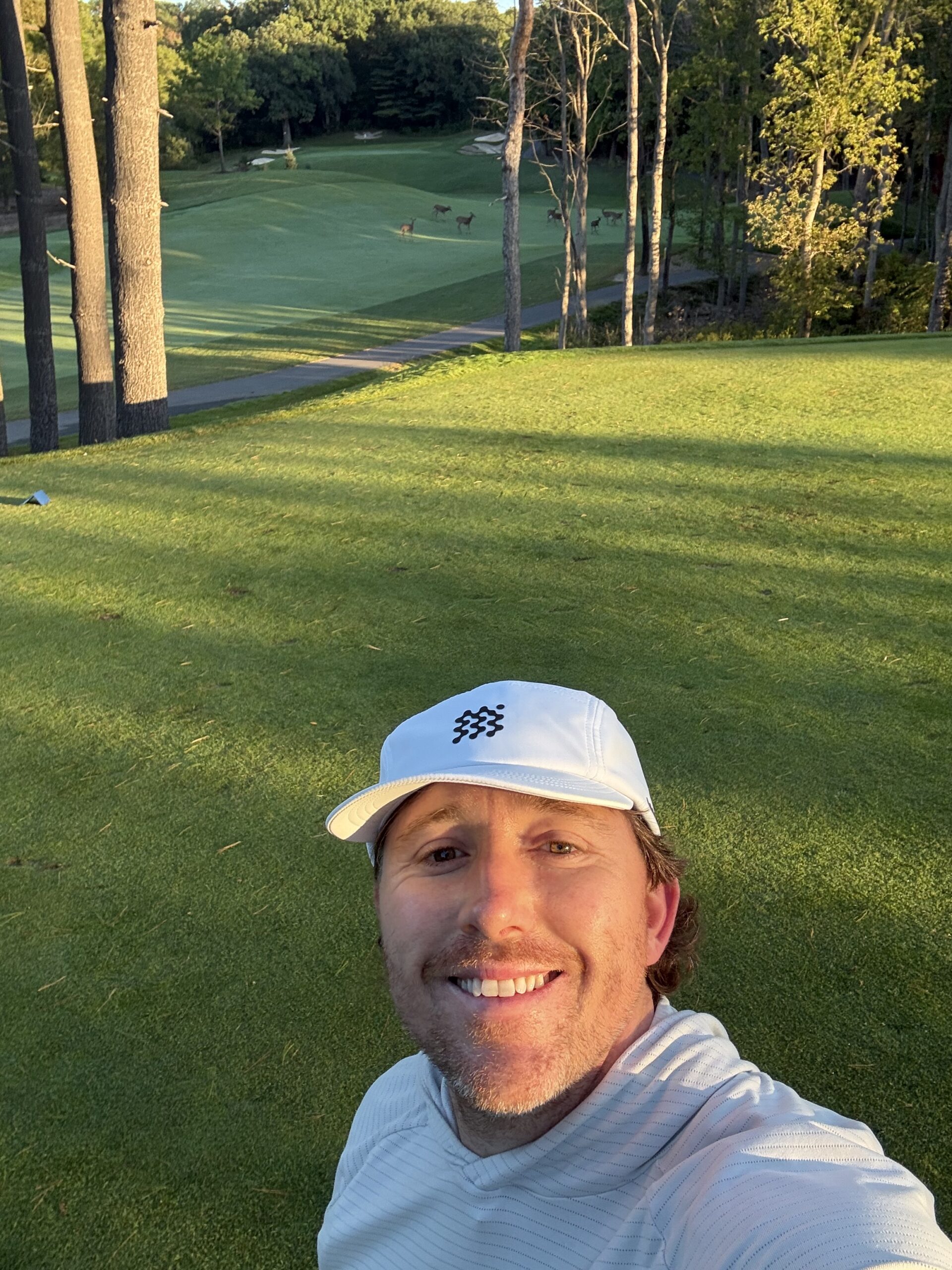
Dr. Eric Nelson at Dundas Valley, 2026
As Hamilton’s golf season winds down, now is the perfect time to address those nagging aches, improve your mobility, and prepare your body for next season. Even with a mild fall keeping golfers on the course longer, the season is officially coming to a close. Whether you regularly play at Copetown Woods, Dragon’s Fire, Dundas Valley, Hamilton Golf & Country Club, Burlington Golf & Country Club, Beverly Golf & Country Club, Crosswinds, King’s Forest, or Glendale, the off-season is an opportunity to work on your body before next spring.
At Function101 Chiro+Physio in Hamilton, Dr. Eric Nelson and Dr. Matt O’Brien help golfers manage injuries, improve mobility, and build the strength and physical capacity needed to enjoy the game.
Our approach combines golf-specific movement screening, hands-on treatment, and individualized exercise rehabilitation. Rather than simply treating the area that hurts, we assess how your body moves and develop a plan that addresses your symptoms, physical limitations, and goals.
Don’t spend another golf season managing the same pain. Use the off-season to get your body ready for next year.
Common Golf Injuries We Treat in Hamilton
The golf swing places considerable demands on your shoulders, spine, hips, elbows, and wrists. Repeated swings, limited mobility, changes in playing volume, and inadequate physical preparation can all contribute to pain.
At Function101, we regularly help active individuals manage musculoskeletal injuries, including golf-related complaints such as:
- Golf-related back pain: Repeated rotation and the physical demands of the golf swing can aggravate back pain and limit your ability to practise or play comfortably.
- Golfer’s elbow: Pain around the inside of the elbow can develop with repeated gripping and loading. Simply playing through persistent symptoms can make the problem more difficult to manage.
- Shoulder pain: Limitations in shoulder mobility, strength, or load tolerance may affect your ability to get into comfortable swing positions.
- Hip mobility restrictions: Limited hip rotation can influence how you move through your swing and may affect the demands placed on other areas of your body.
- Neck and upper-back pain: Repeated rotation and sustained postures can contribute to discomfort during or after a round.
Every golfer is different. Our goal is to understand what is contributing to your particular symptoms, identify the physical limitations that matter to you, and build an appropriate treatment and rehabilitation plan.
Golf-Specific Assessments With Titleist Performance Institute Training
Golfers don’t move like everyone else. The golf swing requires a combination of mobility, stability, coordination, and strength, and limitations in one area can influence how the rest of the body moves.
Dr. Eric Nelson has completed Titleist Performance Institute (TPI) medical screening training, which informs our approach to assessing the physical demands of golf.
Our golf-specific assessment includes screening a series of golf-related movements to identify potential restrictions in mobility, control, and movement patterns. We also consider your injury history, symptoms, playing demands, and goals.
For example, consider a right-handed golfer experiencing shoulder pain.
During the TPI screen, we can assess shoulder external rotation in a simulated mid-iron posture. Ideally, the golfer should be able to externally rotate the shoulder to at least the angle of their spine relative to the ground.
If the golfer cannot achieve that position, we investigate what might be contributing to the restriction. Soft-tissue limitations around the pectoral or latissimus dorsi muscles may be relevant, alongside shoulder strength, hip mobility, and other movement factors.
For a right-handed golfer, the trail shoulder (right shoulder) may be particularly relevant to this assessment. For a left-handed golfer, the corresponding shoulder is the left.
This is one example of how we look beyond the painful area to understand the physical demands of your swing.
Importantly, a movement restriction does not automatically mean it is causing your pain or that changing your swing is necessary. We interpret screening results alongside your symptoms, examination findings, and individual goals.
Our Approach: Hands-On Treatment and Active Rehabilitation
At Function101, we believe effective golf injury care involves more than temporarily relieving symptoms.
We combine hands-on treatment with targeted exercise to help you improve comfort, restore relevant movement, and build the capacity to return to the activities you enjoy.
Depending on your assessment findings, your treatment plan may include the following.
1. Hands-On Treatment
Manual therapy can help manage symptoms and address relevant mobility restrictions.
Depending on your needs, treatment options may include:
- Chiropractic care and manual therapy including mobilizations, adjustments, and traction
- Soft-tissue treatment (Active Release Technique) targeting relevant muscle restrictions
- Sports massage
- Acupuncture or dry needling, where appropriate
- Shockwave therapy for selected conditions
These treatments are selected according to your presentation rather than applying the same approach to every golfer.
For example, a golfer with shoulder discomfort and restricted external rotation may benefit from targeted soft-tissue treatment alongside a programme of shoulder mobility and strengthening exercises.
2. Golf-Specific Strengthening and Mobility
Hands-on treatment is only one part of the process. We also want to help you improve your ability to tolerate the physical demands of golf.
Your rehabilitation may include:
- Shoulder external-rotator strengthening
- Hip rotation and mobility exercises
- Thoracic spine mobility
- Gluteal and trunk strengthening
- Single-leg strength and balance
- Progressive loading tailored to your symptoms and goals
Returning to golf comfortably often requires more than regaining movement. You also need sufficient strength and capacity to tolerate repeated swings, practice sessions, and full rounds.
At Function101, we have an open gym space where we can progress exercises beyond the treatment table and tailor them to your needs.
3. Addressing the Whole Movement Pattern
One of the most important aspects of golf injury treatment is recognizing that the area that hurts is not always the only area worth assessing.
For example, a golfer with persistent golfer’s elbow may benefit from an assessment of the elbow and forearm, but we may also examine shoulder mobility, strength, and the golfer’s overall movement patterns.
This doesn’t mean that every elbow problem originates in the shoulder. Rather, we consider the relevant physical factors that could influence symptoms and rehabilitation.
Our goal is to develop a treatment plan that makes sense for you, rather than focusing exclusively on the painful spot.
Why the Off-Season Is the Ideal Time to Address Golf Injuries
When you’re playing two or three times a week, it’s easy to put off treatment. You might manage your symptoms between rounds, modify your swing, or simply hope the problem settles down.
The off-season gives you an opportunity to take a different approach.
Instead of trying to squeeze rehabilitation around your playing schedule, you can dedicate time to addressing persistent symptoms, improving relevant mobility, and building strength before the next season begins.
Whether you’re dealing with back pain, golfer’s elbow, shoulder discomfort, or a mobility restriction, starting now gives you time to work towards your goals without the immediate pressure of an upcoming round.
Our aim isn’t simply to get you through the winter. It’s to help you build a better foundation for the next golf season.
Serving Golfers in Hamilton, Dundas, Burlington, and Ancaster
At Function101 Chiro+Physio, we work with active individuals throughout Hamilton and the surrounding communities.
Whether your home course is Dundas Valley, Hamilton Golf & Country Club, Burlington Golf & Country Club, or one of the many other courses in the area, we understand that golf is more than an occasional activity for many of our patients.
It’s a regular part of their routine, social life, and overall enjoyment of being active.
Dr. Eric Nelson and Dr. Matt O’Brien understand the game from both a clinical and a golfer’s perspective. We combine that understanding with individualized assessment and rehabilitation to help you work towards your goals.
When the courses close for the season, your preparation for next year can begin.
Book a Golf-Specific Assessment at Function101 Chiro+Physio
If you’ve been managing the same shoulder pain, back pain, or golfer’s elbow throughout the season, now is a good time to have it assessed.
An initial assessment with Dr. Eric Nelson or Dr. Matt O’Brien allows us to understand your symptoms, evaluate relevant golf-specific movements, and develop a treatment plan tailored to your needs.
Whether your priority is resolving persistent pain, improving mobility, returning to the gym, or preparing for next season, we’ll work with you to determine the most appropriate next steps.
Don’t wait until your first round next spring to start addressing the problem.
Book your golf-specific assessment at Function101 Chiro+Physio in Hamilton and use the off-season to prepare for the golf you want to play next year.
Ready to get started? Contact Function101 Chiro+Physio to book an assessment and discuss your recovery options.
Written by: Dr. Eric Nelson, Chiropractor, Certified Strength and Conditioning Specialist, TPI Certified